Same Scene, Different Movie: The Translation Choices That Rewrote Cinema History
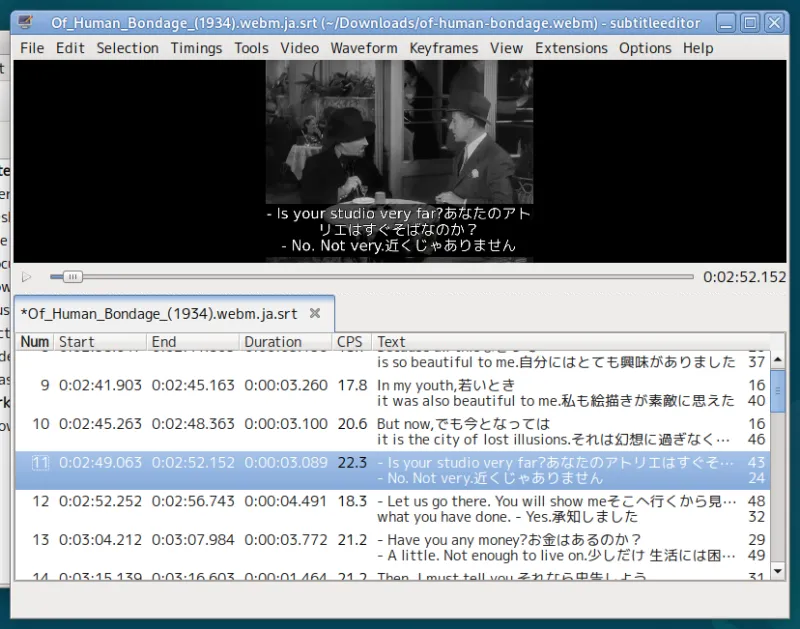
Photo: Trisquelgnu, CC BY-SA 4.0, via Wikimedia Commons
Picture this: you watch a foreign film, fall completely in love with a particular scene, maybe even quote a line from it. Then someone who speaks the original language watches it with you and goes quiet for a second before saying, "That's not really what he said."
It happens more than you'd think. Subtitle translation is one of the most consequential — and least discussed — creative decisions in international cinema. The words that appear at the bottom of your screen aren't just a neutral delivery mechanism. They're an interpretation. Sometimes they're a reimagination. And occasionally, they're something close to a different film entirely.
The Translator's Impossible Job
Before we get into specific examples, it's worth understanding what subtitle translators are actually up against. They're working with a fixed character limit per line, a fixed time window per subtitle card, and the need to match the emotional register of what's being said — all while navigating idioms, cultural references, and linguistic structures that often have no direct English equivalent.
"You're not translating words," one subtitler working in French and English described it. "You're translating intent. And sometimes the intent lives in a grammatical structure that English just doesn't have."
That gap between intent and available language is where the most interesting — and sometimes most damaging — translation choices happen.
When a Confession Becomes a Compliment
One of the most-discussed examples among translation scholars is the English subtitling of certain scenes in Akira Kurosawa's Rashomon. The film's central tension relies on the way each character's version of events is shaped by self-interest and ego. In the original Japanese, the language registers shift subtly between characters — formal, informal, aggressive, deferential — in ways that signal their social positions and psychological states.
Many English subtitle versions flatten those registers into a more uniform literary English. The result isn't wrong, exactly, but it softens the social dynamics that Kurosawa built into the script. Viewers reading subtitles get the plot. Japanese-speaking viewers get the class warfare embedded in how the characters speak to each other.
This is the translation trap that's hardest to spot: not the outright mistranslation, but the smoothing-over of something that was deliberately rough.
The Comedy That Landed in the Wrong Key
French comedies present a different kind of translation problem. Comedy is timing, and timing in French often depends on wordplay, double meanings, or cultural references that simply don't exist in English. Translators faced with an untranslatable French pun have a few options: explain it (kills the joke), replace it with an English equivalent (changes the joke), or drop it entirely (loses the joke).
In the beloved French comedy Le Dîner de Cons — released in the US as The Dinner Game — there are several exchanges that rely on French-specific cultural touchstones. The English subtitles make reasonable substitutions, but viewers who've seen the film in French describe specific scenes as landing harder in the original. The English version is funny. The French version is, apparently, devastating.
This matters because it shapes which films get considered "comedies" in the American market. A film that loses thirty percent of its laughs in translation might get reviewed as a "dry European drama" rather than the crowd-pleaser it actually is at home.
The Line That Became a Meme (For the Wrong Reasons)
Fans of Korean cinema will remember the subtitle debates that erupted around Bong Joon-ho's Parasite after it won Best Picture in 2020. Most of the English subtitling was widely praised — Sharon Choi's work was considered a model of how to handle culturally specific content for international audiences.
But the film also sparked renewed conversation about earlier Korean films that hadn't been so carefully handled. Specific scenes in Park Chan-wook's Oldboy — a film that had been circulating in American cinephile circles for years — were re-examined after Korean-speaking viewers pointed out that certain emotional beats in the English subtitles were slightly off. Not wrong enough to confuse the plot, but off enough that the weight of the scene shifted.
A line that in Korean carries a specific kind of resigned bitterness became, in English, something closer to straightforward regret. Same meaning, different flavor. Different flavor, different scene.
When the Translation Made It Better
It's not all loss, though. Some translation choices have genuinely enhanced the international experience of a film — not by fixing something broken, but by finding an English equivalent that carries the emotional content even if the literal words are different.
The English subtitles for Studio Ghibli's Spirited Away, handled by Pixar's translation team for the Disney release, are frequently cited as an example of subtitle work that made creative choices in service of the film's emotional core rather than strict literalism. Some lines were rewritten significantly from the original Japanese. Most viewers who know both versions agree the English subtitles feel right, even where they don't translate precisely.
This points to a real philosophical split in the translation world: do you serve the text, or do you serve the experience? There's no consensus answer, and different translators will give you completely different frameworks for thinking about it.
How to Find the Seams Yourself
You don't need to speak another language to start noticing translation choices. Here are a few practical ways to engage with the subtitle layer of the films you're watching:
- Watch the same film with different subtitle tracks. Many streaming platforms offer multiple subtitle options. Comparing them reveals where translators made different judgment calls.
- Pay attention to scenes where the emotional register of the actor seems slightly mismatched with the subtitle text. That gap is often where a translation choice happened.
- Read reviews from critics in the film's home country and compare them to American reviews. Differences in what gets praised or criticized often trace back to what was gained or lost in translation.
- Seek out films with multiple English subtitle versions — older foreign films that have been rereleased often have new subtitle translations, and the differences can be revelatory.
Why It Matters That You Know This
None of this is meant to make you distrust subtitles or avoid foreign films. Quite the opposite. Understanding that subtitles are a creative act — not a transparent window onto another language — makes you a more engaged and more appreciative viewer.
The best subtitle translations are acts of genuine artistry. The worst ones are cautionary tales about what happens when that artistry is rushed, underpaid, or undervalued. Either way, knowing the layer exists changes how you watch.
Next time a scene hits you hard, it's worth asking: is this what the director put there, or is this what the translator built? Sometimes the answer is both. Sometimes it's neither. And sometimes, honestly, the translation made something the original never quite managed.
That's the strange, beautiful, slightly unsettling thing about watching the world's cinema through someone else's words.